DevOps Pipeline view
The DevOps Pipeline view draws your branches, where each one merges and the Salesforce org each one deploys to, with the open Pull Requests and the status of the last deployments. Below the diagram, cards start every step of the contributor workflow.
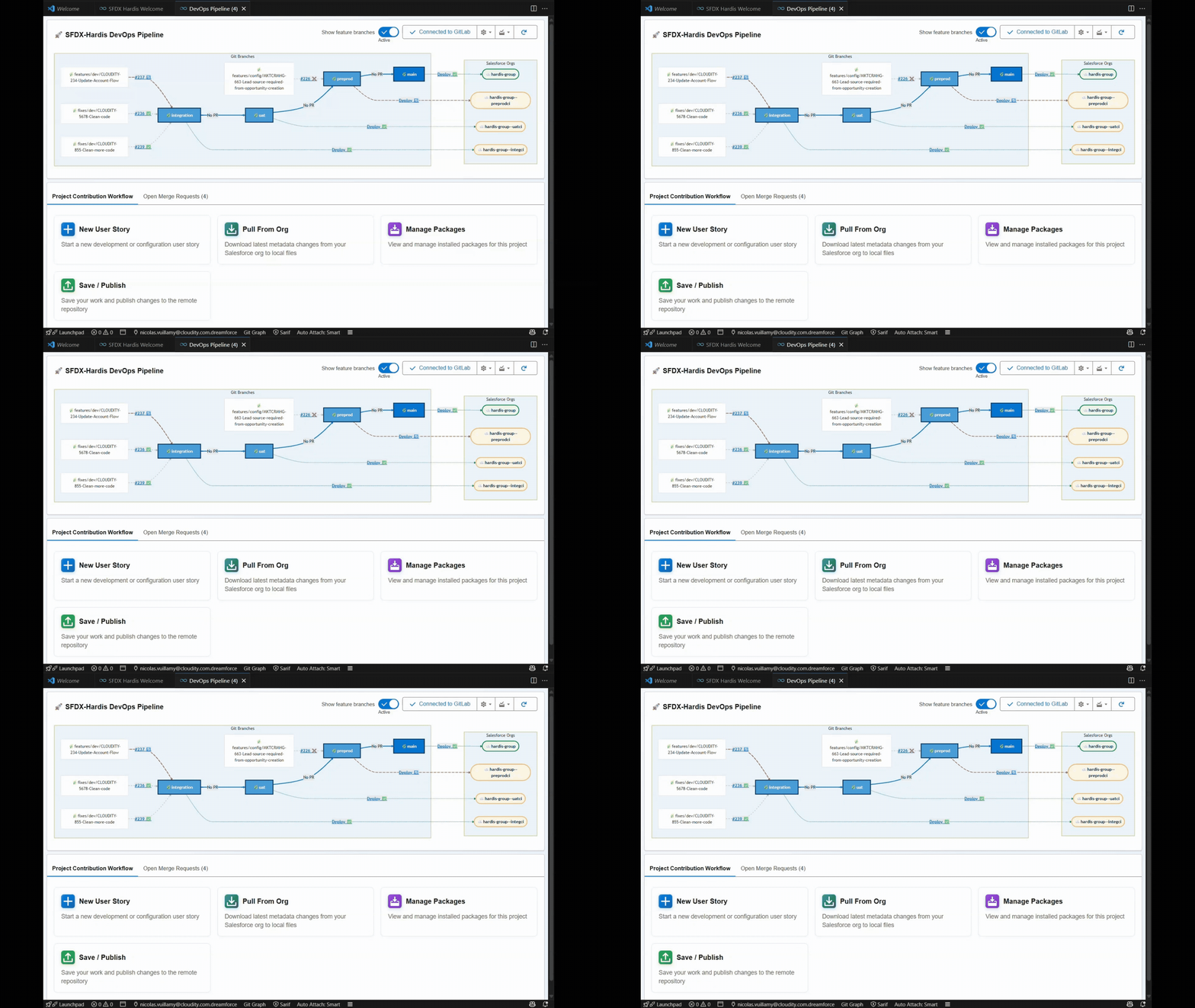
For the concepts behind it (major branches, merges, delta deployments), read Salesforce CI/CD first.
Open it
- Click DevOps Pipeline in the CI/CD (simple) menu of the side bar.
- Click the DevOps Pipeline card of the Welcome panel.
Read the diagram
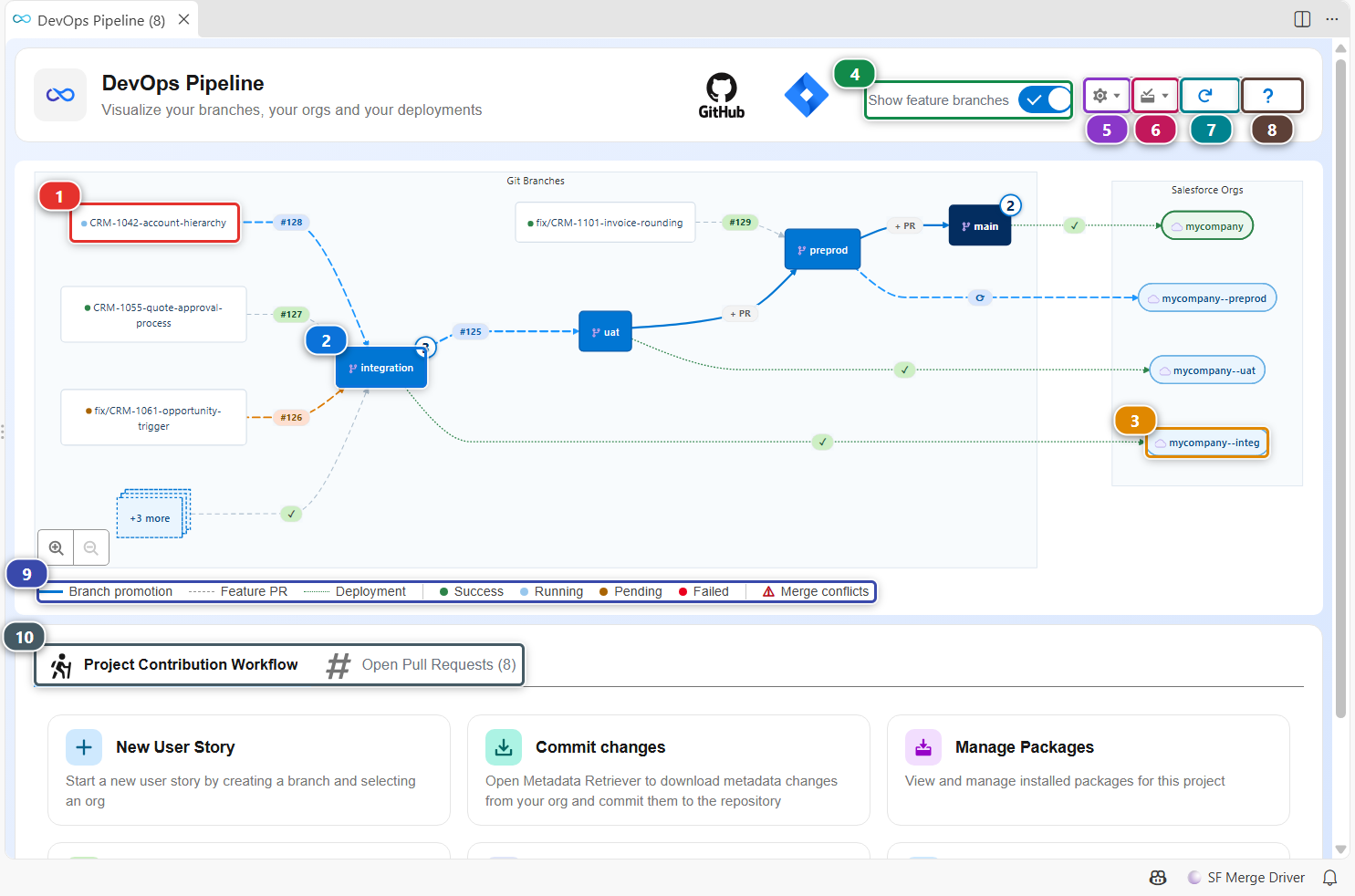
- (1) is a feature branch, with the number of its Pull Request. When too many target the same branch, they are grouped in a +N more box.
- (2) is a major branch. The badge on its corner counts the Pull Requests open against it. Click it to see its Pull Requests, tickets and deployment actions.
- (3) is the org a major branch deploys to. The dotted line carries the result of the last deployment: a check mark when it passed.
- (4) shows or hides the feature branches. They are shown by default.
- (5) opens the pipeline settings menu, (6) the package files menu, (7) reloads branches, Pull Requests and deployments, and (8) opens this guide.
- (9) is the legend of the lines and statuses.
- (10) switches between the contribution cards and the list of open Pull Requests.
Start and publish a User Story

The cards follow the order of the work:
- (1) creates the branch of a new User Story and selects the org to work in. See Start a User Story.
- (2) opens the Metadata Retriever to pull what you changed in your org, so you can commit it.
- (3) installs or updates managed packages. See Install packages.
- (4) cleans your changes, pushes them and opens the Pull Request. See Publish a User Story.
- (5) shows the Pull Request of your current branch, with its tickets and deployment actions.
- (6) brings into your development org what your teammates merged in the parent branch. See Backpromote.
Add a deployment action to your Pull Request
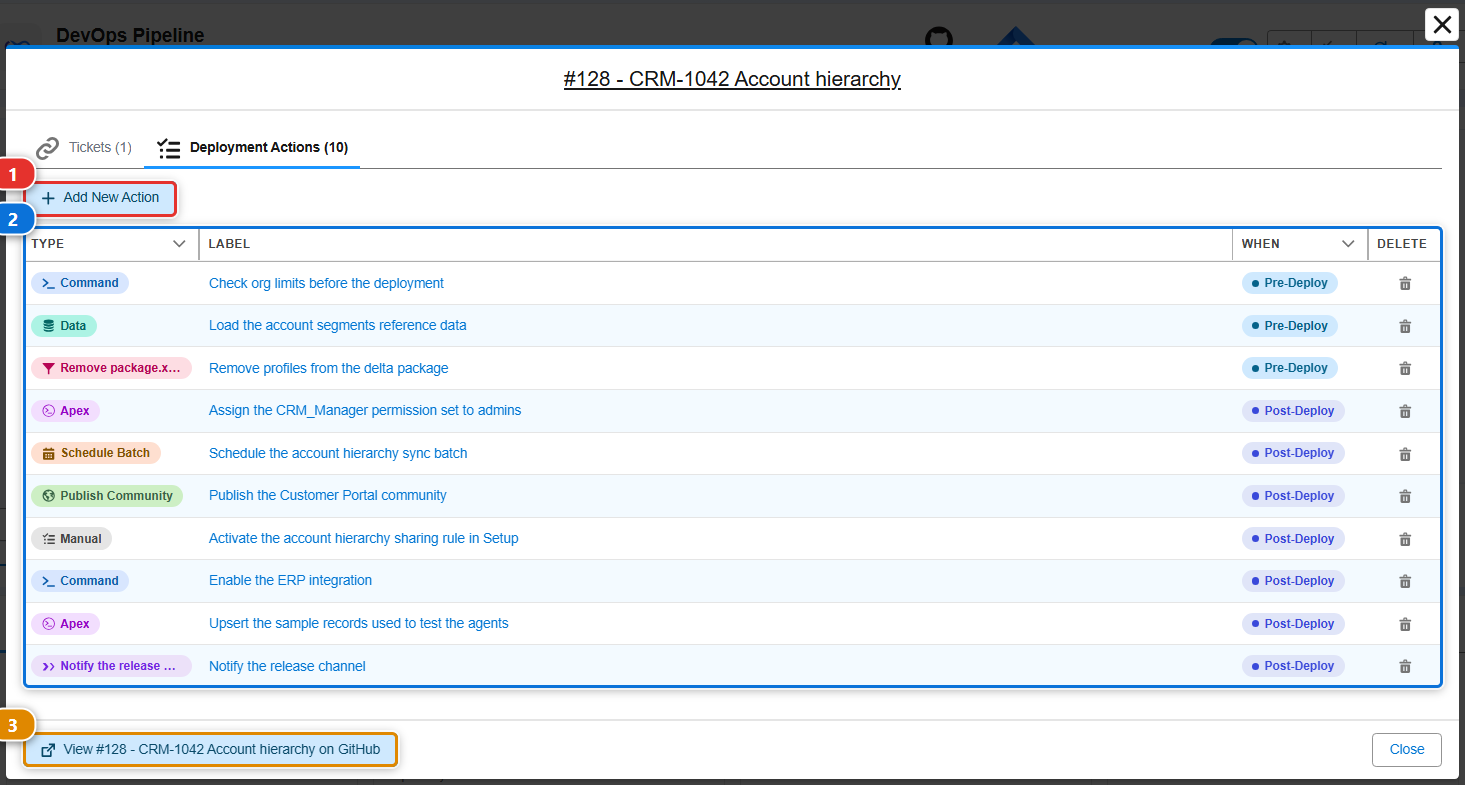
Some changes need a step that metadata alone cannot do: load reference data, run an Apex script, assign a permission set. Open your Pull Request with the My Pull Request card, then its Deployment Actions tab.
- Click (1) to add an action, pick its type and when it runs (before or after the deployment).
- The table (2) lists the actions of the Pull Request. Click a label to edit it, or the bin to delete it.
- (3) opens the Pull Request on your git provider.
The actions run automatically when the Pull Request is deployed. See Deployment actions for every action type.
Review what is about to be deployed to a major branch
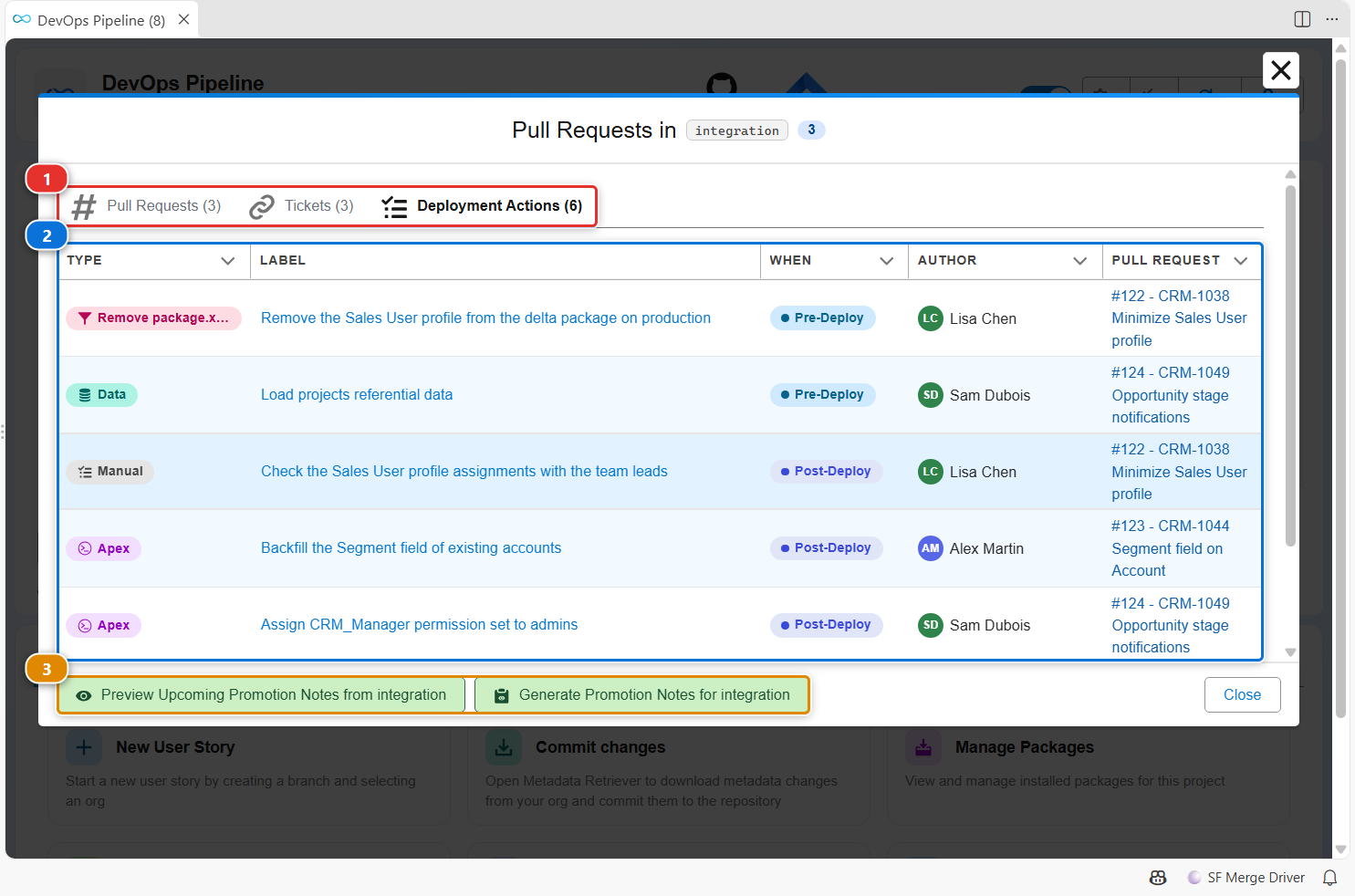
Click a major branch in the diagram. The window lists the Pull Requests merged into it:
- (1) switches between its Pull Requests, the tickets they mention and their deployment actions.
- (2) lists the deployment actions of those Pull Requests, with their author and their Pull Request.
- (3) previews or generates the promotion notes of the next merge to the upper branch.
Configure the pipeline
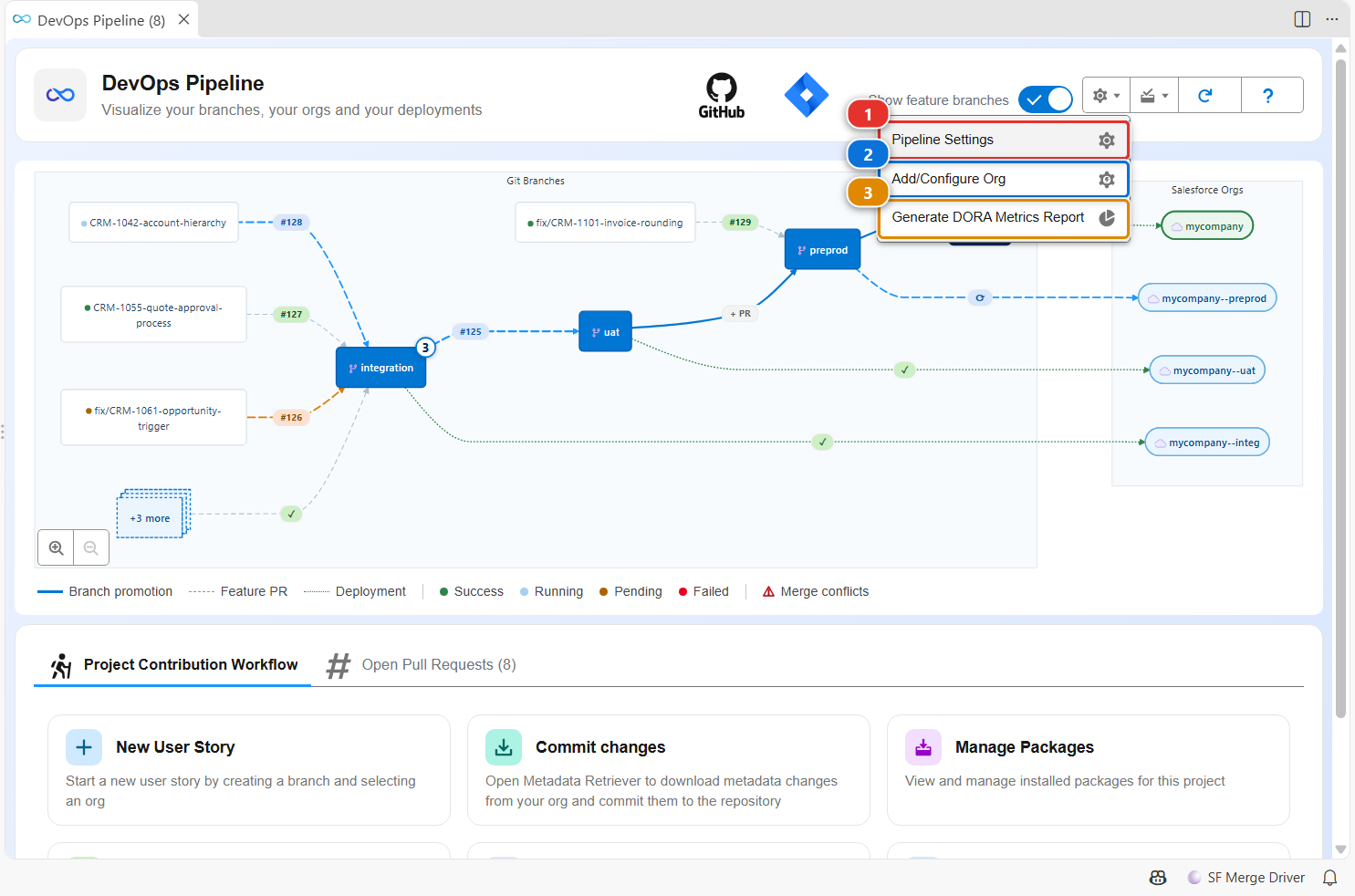
The gear menu gathers the settings of the project:
- (1) opens Pipeline Settings, the editor of
.sfdx-hardis.yml: branches, deployment options, tickets, notifications. See Configuration. - (2) connects a major branch to its org, so the CI/CD pipeline can deploy there.
- (3) generates a DORA metrics report of the deployments (frequency, lead time, failure rate).
Edit the package files
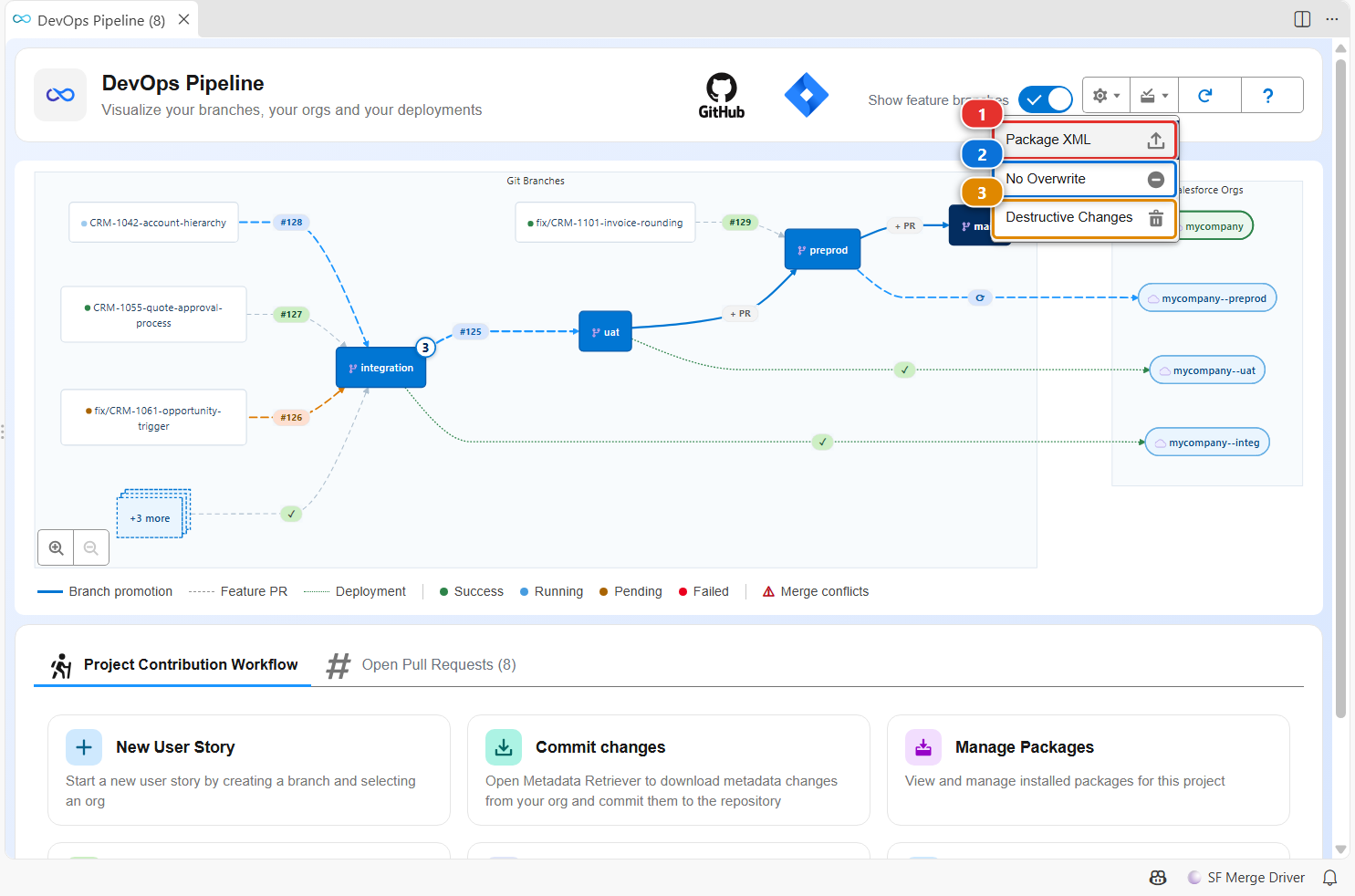
The second menu opens the package files of the project in a visual editor:
- (1)
manifest/package.xml, what the pipeline deploys. - (2)
manifest/package-no-overwrite.xml, metadata that is created once and never overwritten afterwards. - (3)
manifest/destructiveChanges.xml, metadata to delete in the target orgs.
See Configure overwrite management for when to use each one.
Customize
| What | Where |
|---|---|
| Hide feature branches | The Show feature branches toggle, or the vsCodeSfdxHardis.pipelineDisplayFeatureBranches setting (default true) |
| Group feature branches after N | vsCodeSfdxHardis.pipelineFeatureBranchGroupThreshold (default 3) |
| Branches, orgs, deployment options | Pipeline Settings, stored in .sfdx-hardis.yml |
| Promotion branches | enablePromotionBranches, see Promotion branches |